
By Saqeeb Saeed.
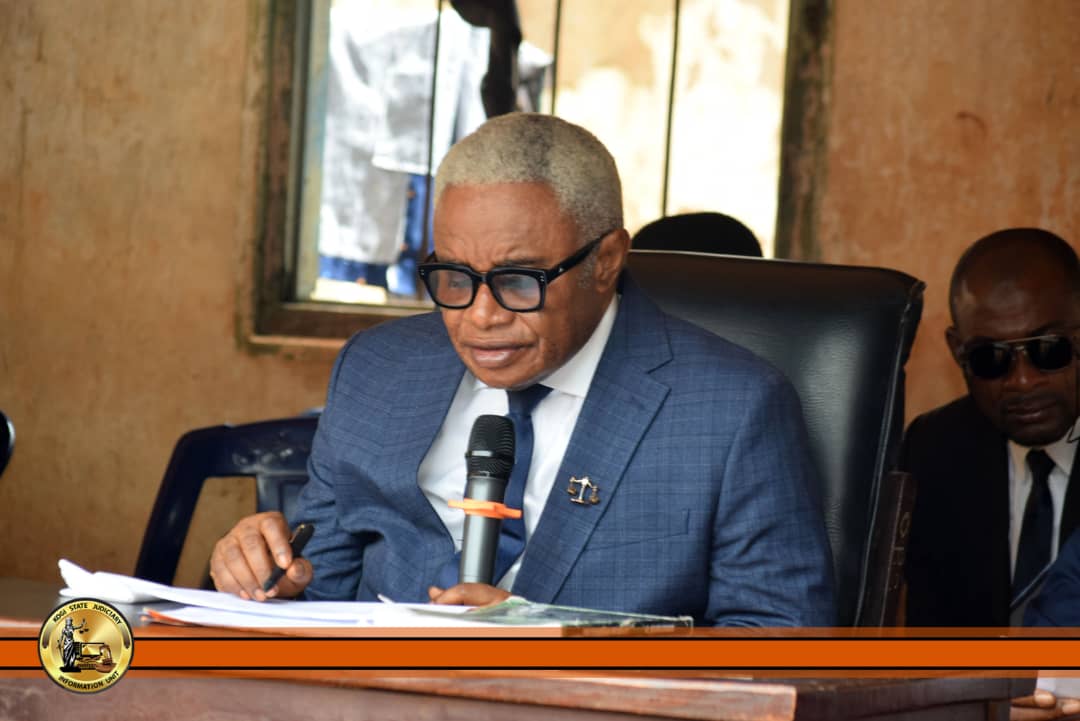
13 Awaiting Trial Inmates in some custodial Centres of Kogi State regained their unconditional freedom when the Chief Judge of the state, Hon. Justice Josiah Joe Majebi, embarked on prisons’ decongestion exercise last week. The Chief Judge also used the exercise to advocate for effective administration of criminal justice stressing that the integrity, credibility and image of the Judiciary rely majorly on stakeholders in the Justice delivery sector especially at a time when Nigeria’s judiciary is undergoing fundamental reformation.
A diligently effectual discharge of core mandates by respective stakeholders
in the administration of criminal justice cannot be overemphasized he said.
Visitations to Nigeria’s Correctional Centres by the authority and influence of a Chief Judge of any state in Nigeria, is by statutory implication, to ensure that sanity prevails in the country’s prisons, which have become custodial and correctional centers, as provided by law. The implementation of those extant laws by the strategic stakeholders has the mandate of ensuring that citizens’ rights are protected and not abused, especially when it relates to their freedom he said.

According to Justice Majebi, the provisions of the country’s constitution and other guiding laws and principles are often found in policies which are aimed at attaining the intentions of the laws that must not be compromised.
These observations were conveyed during the week-long decongestion exercise that took him across the three Senatorial Districts of the state to review cases of all awaiting trial inmates.
Kogi State has six Medium Correctional Centres located at Koton-karfi, Kabba, Okene, Idah, Ankpa and Dekina. While the days of the week devoted for the exercise were strenuous they were however remarkable in outcome.
Begining with the journeys that took him and his entourage across roads, some of which were smooth, some undergoing reconstructions and others rugged, bumpy or completely dilapidated. The worst was the one that led to the ancient town of Dekina. With the determination to see that three categories of people who should not continue to languish in jail while their trials were ongoing must be reviewed, the CJ was however less bothered by the condition of the roads.
Those whose cases are to be reviewed involved citizens and residents of the state who were deemed illegally incarcerated, either by virtue of misapplication of extant laws by agents designated to do so or by virtue of neglect.
The first category were those whose trials may have been unnecessarily prolonged. The second, those who may have possibly spent beyond the time prescribed as punishment for their alleged offence and the third, those whose detention completely lacked basis in law.
Virtually all these were found across the state but particularly at Koton-karfi prison where those awaiting trial numbered 124. In Kabba, they were 22; Okene had 34; Idah, seven; Ankpa, eight and Dekina, 11.
In addition to agents of the High Court of Justice of the state saddled with the responsibility of administering criminal justice which comprises the High Court of Justice, the Magistracy and the Area Court system, other agencies that constitute stakeholders in the administration of criminal justice in the state, and who were on the CJ’s train, were officers of the state’s Ministry of Justice led by the Director of Public Prosecution, Iye Idama Esq., on behalf of the Attorney-General and Commissioner for Justice and the Nigeria Correctional Service in whose custody the awaiting trial inmates were kept.
Others were the Nigeria Police, led by the Officer in Charge of Legal, Idowu Ikutonwa, who represented the Commissioner of Police; Legal Officer of the Directorate of State’s Security Services, Isaac A; Kogi State’s Office of the Public Defenders and Citizens’ Rights Commission led by Idris Onogo Esq.; the Nigeria Bar Association initially with the Lokoja Bar Chairman, Sumaila Abbas Esq.; the Legal Aid Council’s Kevin Fanaiye; National Human Rights Commission’s Ogirima Etudaiye; Nigeria Security and Civil Defense Corps’ Sunday Owuno.

Justice Majebi commenced the exercise on Monday, 1st June, 2026, at Koton-karfi bearing in mind the inalienable rights of citizens in incarceration who may be potential beneficiaries of the exercise.
In recognition of this, he reviewed all the cases of the total number of every single inmate awaiting trial across the six custodial centres.
The begining of the exercise at Koton-karfi set the pace for what to expect in the course of the exercise as 10 unlawfully detained inmates were granted unconditional freedom by the CJ.
Before they regained liberty however, clarifications were sought and certain confirmations gotten from the prosecuting agencies and trial Magistrates and Area Court Judges by the CJ.
There was an enablement for the High Court divisions across the state on which were rested superiority. Those standing trials before them were though taken cognizance of but were exempted from the critical review. They were therefore olny and asked to go and await the determination of their cases by the courts.
At Koton-karfi, the Administrative Magistrate, Mopa Abdullahi Esq., acceded to the CJ’s calls on assigning cases properly and conceded grounds on impropriety after acknowledging provisions of the law. He consented to adjustments within directives given by the CJ on case file management just as his Registrar, Mrs. Zacheus Victoria, was given a week suspension for a missing case file and patronage of a professional surety known as Master.
Similarly, instructions of same nature were issued at all other centers visited as the CJ insisted on compliance with provisions of law, and regulatory policies, on detention of defendants being tried by lower courts.
*Trial timeline:*
Remand proceedings came under scrutiny with the DPP clarifying on issuance of Ministry’s Legal Advice. Some inmates regained freeform through Legal Advices that cleared them of cases to answer. At interval, further clarifications were made by the police O/C Legal, who justified detentions or causes of delays in trials of some cases.

However, the CJ directed that cases should not last more than one month from date of taking the defendant’s plea insisting that cases must be determined without recourse to taking dates for further hearings.
*CJ Rues Improper Prosection, Orders Striking Out Of Prolonged Cases*
The next day at Kabba custodial centre was particularly not palatable for prosecutors in the state as the CJ ordered that poorly prosecuted cases be struck out.
As High Court Judges on the CJ’s entourage lend observations and suggestions, in line with the mandate of the Council of Judges he inaugurated when he assumed office, the Council’s ideological depth pervaded throughout the exercise.
Hon. Justice Zubair Saliu, the resident Judge at Kabba, noted the lacklustre attitude of prosecuting agencies in the area and coupled with similar complaints entertained the previous day indicating poor prosecution, the CJ ordered such cases to be struck out. He enjoined all lower court judges to enforce the order else they would be disciplined for gross misconduct.
He said it was no longer acceptable for cases to linger in Kogi courts for reasons of prosecutorial defects which he said was not within the purview of the Administration of Criminal Justice Law.
Besides, he said the judiciary bears the brunch of public criticism for delayed cases while ignorant of the antics of prosecutors and that was no longer acceptable and must be stopped.
It was no more agreeable to have awaiting trial inmates remanded in prison while agencies saddled with the responsibility of prosecuting them are not forthcoming. The law pressumes defendants innocent untill they’re proven otherwise, he added.
He further directed that parties in matters should only be granted adjournment twice and such adjournment must not be more than one week.
Granting unwarranted adjournment in cases, especially at the instance of prosecution,
put the judiciary in bad light and the institution should not be seen to be complicit in prosecutorial indolence he maintained.
However, three
inmates secured freedom at Kabba through normal court process. Magistrate Suzan Adaji, the presiding Magistrate, would have delivered judgment on their matters that day but she was present at the custodial centre for the decongestion exercise. As a result of that, the CJ, ordered that a Magistrate court room be made available for her in the town to deliver the judgement while he continued with his review of other cases.
The eventual outcome of the Magistrate’s delivery of her ready judgement was the freedom of the three defendants as she later returned to report while the exercise was still ongoing at the centre.
The CJ’s train left for Okene afterwards. The Okene custodial centre is the only facility in the state that accommodates women. Emotions almost took over everyone in attendance when a baby-feeding mother appeared, amongst the five women presented for the review, carrying her baby.
Touched was the Legal Aid Council’s representative, Kevin Fanaiye Esq., that he raised the possibility of separating the baby, but the CJ pointed out that nature’s demand made separation of mother and child impossible. But even as the record officer at the centre disclosed that the 18 months provided by law for such categories of inmates was almost exhausted, the CJ directed her accelerated trial after reassigning her case to another High Court Judge, Hon. Justice Ada Beatrice, following the demise of the former trial judge, Hon. Justice Yahaya Adamu, who passed on recently.
None of the awaiting trial inmates in Okene, Idah, Ankpa and Dekina were found worthy of release as their trials were deemed to be running progressively in various courts.
As the exercise came to an end at the Dekina custodial centre, Justice Majebi reiterated his orders throughout the exercise.
He noted that the exercise was resoundingly successful even though the days devoted for it were strenuous.
*Courts restored, cases transferred:*
Just like a few others, Idah jurisdiction of lower courts received a serious attention for reason of congestion of cases. Unlike others though, issue of natural restriction, which is usually occasioned by flood, made Idah a peculiar case. As a result, cases that were supposed to be heard at Ibaji, a nearby community, were unofficially transfered or instituted and found to be undergoing trials at Idah.
This led to over congesting the Area courts in Idah, in similar manner to other places like Felele under Lokoja, Okpo and Imane under Ankpa and in Kabba region while the Magistrate’s courts there were underfed. It was observed that the Areas Courts that became so overburdened by cases stretch their adjournment beyond acceptable length of time, sometimes covering more than three months. At Idah, in particular, Judges, prosecutors and lawyers had issues relating to nominal complaints, adjournment and hearings.
In reaction to this development, the CJ ordered the restoration of the functioning of all courts at Ibaji, which were abandoned for fear of flood, stating that since people still live in the community, courts originally situated there were meant to take Justice closer to the people and that shouldn’t be denied under any guise.
In addition to the order, even though he said no court was being denied their rights, he said the prevailing circumstance required an immediate redirection and therefore instructed that all criminal cases before Area Courts that have not been commenced in the areas affected, be transfered to Magistrate courts immediately. The Deputy Chief Registrars for the Magistracy and the Area Courts were mandated to ensure the smooth transfer of the cases within one week while such cases must be determined within one month if receipt by their recipients.
In his recap at the Dekina custodial centre where the exercise terminated, the CJ said the exercise was effective and eventful considering the number of awaiting trial inmates reviewed across the state.
He noted that all the three categories of courts in the state had cases pending before them while those before divisions of the High Court of Justice were not reviewed. The cases, according to the CJ, were receiving appropriate and timely attention in line with the directive of the National Judicial Council.
*The Lower Courts:*
He reiterated that all lower courts in the state must adhere strictly to the provisions of the law while hinting at a possible review of remand proceedings to curb abuse.
He urged Magistrates and Area Court Judges to take charge of their courts and refuse to grant frivolous adjournment recalling his directive throughout the exercise that adjournment must not be granted more than twice at the instance of both parties.
While recalling that he spent most of his service years at outstations, the CJ warned lower court judges who don’t stay in their stations to desist or they should be prepared to face the consequence.
In line with that directive, he disclosed that, against his earlier believe in treating Magistrates and Area Court Judges based on seniority, he has since rescinded that decision and he presently evaluate them based on performance, competence, diligence and commitment. This he said, could make it possible for a more dedicated and productive younger officer to be placed above his or her senior when considerations for elevation, postings and other benefits matters and such seniors should not be surprised.
In the same vein, he disclosed that the Performance Evaluation Committee of the Judicial Service Commission would soon be activated, when resources of the Commission improves, so as to begin performing it’s duties he added.
*Bail bonds:*
The CJ frowned at collection of cash as part of conditions for granting bail to defendants. He made reference to a particular case where a demand of the sum of N250,000 was made by officials of a lower court to grant a bail. He directed that no Judge or officer of the court should demand any cash payment from litigants warning that any report to that effect would be treated as gross misconduct and the Judge or officer involved would be disciplined accordingly.
According to him, the law dealing with bail bond only requires that a surety be verified, and where there is any need for funds to be legitimately deposited with the courts, such should be deposited in the Chief Registrar’s bank account officially designated for such purposes. Such deposits must become the practice henceforth with the particulars and other details of the case attached to the deposit.
He further directed that conditions if Bali must be given in such ways that defendants could afford. Bail conditions requiring landed property in particular must be limited to the place of residence of the defendant.
*Stakeholders:*
All stakeholders were appreciated even as the CJ expressed satisfaction with their conducts and sacrifices during the exercise.
*Government involvement:*
First amongst those who received the Hon. CJ’s appreciation was His Excellency, Governor Ahmed Usman Ododo, for providing the resources that made the exercise possible. He noted that the state would be the utmost beneficiary if the exercise is made more regular.
In this direction, he commended the Chairman of Idah Local Government Area who was represented at the Idah correctional centre by his vice. He noted that the Chairman was the only one who showed such interest and advised political office holders to always take the welfare of prison inmates as important as those of free citizens and the custodial environment into account too. He said all citizens, whether free or not, deserve to enjoy every governmental interventions reminding that those who are incarcerated still have futures to live and must therefore be aided to achieve that.
*Prosecution:*
The Police OC Legal, Idowu Ikutonwa, whose leading role in prison decongestion exercise was the first time, received commendations for his balanced position and was encouraged to continue same. The CJ however said should he change in the future, it would as well be noticeable and he would be condemned just the same way he was commended.
Justice Majebi then called for caution in framing charges against defendants stating that some IPOs often compromise the system by laying grievous allegations when suspects refuse to ‘cooperate’ with them. He reminded the police legal officer that matters still undergoing investigation should not be brought to court untill the completion of the investigation.
The DPP, Mrs. Iye Idama, Esq. and her team, which also included her Deputy, Mrs. Adejumoh Christina, was praised for a remarkable input during the exercise. Referring to his days in the Ministry before his appointment as a Judge of the High Court, the CJ reminded them that the prosecution of defendants by Legal Officers in the Ministry must always be given full attention while also urging the DPP to always be clinical before issuing Legal Advices.
*The NBA:*
Legal practitioners and Judges of the lower courts were encouraged to continue being diligent as the CJ ascribed the lower number of awaiting trial inmates in some custodial centres to evidence of their good work. He particularly praised NBA Idah for the sensitive issues raised during the visit which he said aided critical decisions taken over cases in the area.
*Correctional Centres:*
The Nigerian Correctional Service’ Controller of Corrections, Kogi State Command, Hajia Hadiza Inna Aminu, and her superintendents were praised for keeping the Custodial Centres clean just as all officers in all the Centres received the CJ’s applause for giving adequate attention to inmates’ health.
All the Superintendents In-Chage of the Centres highlighted the challenges of logistics they faced in transporting inmates to courts since they all virtually cover large jurisdictions with quite a large number of courts they are serving. For these challenges and those of provision of skills acquisition equipments, over which they sought the CJ’s intervention, he promised to liaise with appropriate authorities as he said he couldn’t give what he lacked. Notwithstanding however, the High Court, through the Chief Registrar, Jubril Oladimeji Ibrahim Esq., gave a little token of undisclosed amount of money to each of the Centres to help in providing for maintenance of inmates’ hygiene.
At Dekina in particular, Superintendent Yakubu Hassan Jimber was impressive with the display of the products produced by convicts. They include bags, caps and even artistry products, like fine art works and rings produced from palm kernel shells. While the CJ purchased some personally for motivation, he bought the art image of the governor of the state, drawn by one of the convicts, which he handed over to the DPP for onward delivery to the governor through the Attorney-General of the state.
*Inmates:*
The CJ observed that majority of the inmates whose cases were reviewed were young people who still had tomorrows to nurture and he therefore called on the society to be conscious of the implication of their gradual drift.
He reminded everyone involved in administering criminal justice that their being in custody does not mean they were condemned but that they should rather be helped to regain themselves to be useful to themselves and the society after serving their jail terms.
*The Media:*
Media presence throughout the course of the exercise did not escape the CJ whose words of gratitude to them were much. He craved the appropriate reportage of what transpired noting that the media was a vital partner in the administration of justice and should not therefore always mislead the public by reporting accurately. He said all proceedings throughout the exercise were transparent and should be so made available to the public without misinformation.
While also seeking the continuous cooperation of every organ that contributed to the success of the exercise, the CJ said he was convinced that the administration of criminal justice would always enjoy the expected input of all stakeholders in the state whenever they are called upon.
Finally and on the prompting of Hon. Justice Salisu Umar, the CJ granted the request and Hon. Justice Moses Gwatana gave a vote of thanks on behalf of the Judges and all other members of the CJ’s entourage for what he termed the CJ’s humility, directions and purposefulness throughout the exercise. He prayed that God Almighty continues to rightly guide the him and his leadership for the benefit of the judiciary, the state and the nation entirely.
Husseini Abubakar-Editor.