By Saqeeb Saeed.
The implementation of an advocacy project in Kogi State Judiciary and other related activities by the state’s branch of the International Federation of Women Lawyers in Nigeria (FIDA) received the commendation of the Chief Judge of the state, Hon. Justice Josiah Majebi, who also disclosed that the state judiciary has been gender sensitive in all it’s considerations.
The CJ gave the organisation the pass mark at the judiciary headquarters in Lokoja, the state capital, yesterday, during a seminar the organization held in continuation of its internationally-backed program tagged
“Envisioning An Institution Of The Future And A Strategy For Change With The Kogi State Judicial Service Commission”. The seminar had the theme:
“Strengthening Women Inclusion And Advancement in Nigerian Judiciary Through Institutional Reforms.”
The CJ gave the commendation while responding to requisitions on vital data that were critical to the organisation’s implementation of the project intended to improve on women inclusion in the judiciary.
Components of the entire project, as earlier presented by both the country Vice Chairperson, Mrs. Elena Martins, and the state’s Chairperson, Mrs. Kemi Omeiza, were to include strengthening institutional partnership through gender inclusion in judicial appointments, training, promotion and mentorship. According to them, all states’ Judicial. Service Commissions in the country were initialky evaluated, specifically on gender-related issues, but only three were approved to pilot the project for a period of five years terminating in 2031.
The Country Vice Chairperson added that as women lawyers, the advocacy was consistent with FIDA’s philosophy of scaling up laws, policies and practices for gender inclusivity in the judiciary and other work places.
The state Chairperson had, during the project’s previous introductory visit said that Benue, Kogi and Sokoto States’ Judiciaries were picked after questionnaires were distributed to staffs for proper auditing and accountability. Comparisons made of responses to women-related topics resulted in the choice of the three states after satisfying the benchmark.
In tune with the theme of the seminar, the Chief Judge appreciated the honor given to Kogi State as one of the recipients of the project in the country while stressing that the state judiciary has always been gender-sensitive in decisions, policies and practices. He added that investing in women advancement and their inclusion at all levels has been an uncompromised policy in the state judiciary.
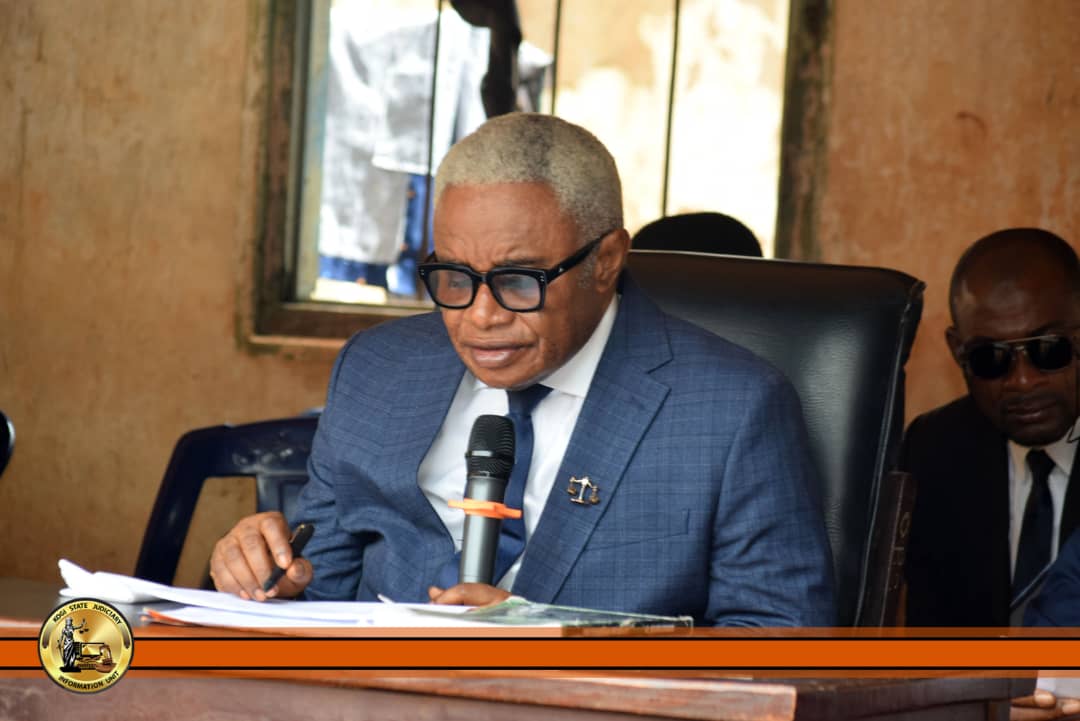
To demonstrate this position, he directed a moot court be staged for emphasis. He presided over the court which had an allegation of gender inequality in the state’s judiciary as the only matter before it.
FIDA was the complainant in the case while the state’s JSC was the defendant. While Mrs. Tina Ekele appeared on behalf of FIDA, Dr. Tanko Mohammed, the state’s JSC Secretary, appeared as the defendant.
In the court proceeding, the court clerk called the case and the complainant presented her case alleging that women in the state’s judiciary were not being adequately represented at all levels and there was need for institutional reforms to correct the ‘anomaly’.
The Defense however said that the reverse was the case in Kogi State Judiciary. He told the court that in the state’s Judicial Service Commission in particular, apart from him, all other Directors in the commission were female; in the High Court of Justice, eight of its 16 Directors were females and of its existing four Deputy Directors, three were females.
He stated in his defense too that in addition to this, there was equal percentage of both genders producing two Judges each in the four recently appointed Judges of the High Court. He concluded that similar gender-sensitive practices were presently observable in the state’s Customary Court of Appeal, the Magistracy and the Area Court system just as he also added that the general staff record shows the same trend which summed that Kogi State Judiciary has been fair enough to women. He therefore urged the Judge to dismiss the complain saying the allegation was highly prejudiced and lacked merit.
In delivering his judgement, the CJ and the presiding Judge of the court, ruled that having listened to both parties, it was clear, in his view, that women in kogi state judiciary were well represented and therefore issues of non-inclusion in all spheres of the institution’s human capital were not applicable.
“With what we have before the court, the complainant has no evidence to substantiate her claims while the defendant, on the other hand, argued with adequate evidence giving figures and facts. Hence, the complaint is without merit and the case is hereby dismissed”.
The CJ however noted that the complaint was well taken and there was room for improvement in terms of appointments and general inclusion noting though that it would not be an isolated issue, but a cause to be pursued and achieved through stronger and productive collaborations at all levels. He assured that the intended objectives of the project would be achieved in the state as they also constitute part of his priorities as the Chief Judge of the state.
He thereafter thanked the leadership of the organisation, the Managements of the JSC and the High Court and participants after his judgement received a loud applause following which the Resource person and Project Manager, Mr. Fiki Obaro, made his presentation.
While illustrating the report of the auditing of the state judiciary, Mr. Obaro noted that the three selected states were considered on the basis of their gender inclusivity through thier gender-related policies and dedication to promoting gender-based practices. He cited Sokoto State Judiciary where a woman was appointed a Chief Registrar in the Sharia Court despite women’s statutory restriction to the court’s bench.
The crux of his presentation considered whether Kogi State Judiciary has institutionalized and has been supporting women-inclusion, whether it partly allocates annual budgets for protection of women interests, properly documents gender-related issues, has existing framework or protocol for promoting and sustaining women and whether it has preexisting institutional strategy specifically for the growth or development of women.
During the course of the seminar, the CJ further made clarifications on many other issues relating to the appointment, promotion and welfare of women stressing however that regardless of the intentions of the leadership of the three arms of the judiciary and the JSC on women protection, funding, which was not exclusively in the control of the judiciary, was determinant to policy formulations and implementations. While stating that funding was not adequately forthcoming, he was however optimistic that the several propositions the judiciary has placed before the state government would eventually see the light of the day. When that is achieved, he said, every staff would enjoy their rightful entitlements and such initiatives as creche, for nursing mothers, clinic and other facilities and programs peculiar to women advancement would be made available.
Aside that, the CJ promised to also propose reservation of certain percentages for women to be considered by the National Judicial Council during Judges’ appointments.
The Project Manager added that at the end of the five-year program, it would be seen if the state Judicial Service Commission has achieved gender representation in all the key areas enumerated in terms of appointments, mentorship, training and protection through policy formulations and documentation. He regretted that several institutions in the country were still gender-biased even at leadership level and the advocacy project was intended to bridge the gap both at federal and state levels.
Both the country and state leadership of the organisation consequently appreciated the Chief Judge, acknowledged the management of the state judiciary for its gender proactiveness and looked forward to the positive gains of the project.
In her closing remarks, the state Chairperson thanked the Hon Chief Judge, the Management and staff of both the JSC and the High Court, the selected participants and her members for their contributions and support just as she also appreciated the resource person for well-articulated strategies towards achieving the vision of the project in the next five years in the Kogi State Judiciary.
Husseini Abubakar- Editor Newsnowexpress.